


How to taste wine like a pro

Flakon offers a wine-tasting experience you can enjoy alone or with others. Discover the world of exceptional wines while learning the secrets and techniques of a good tasting through fun methods accessible to everyone!
This guided wine-tasting experience comes with tips marked by this symbol 👁️🗨️ Follow them to make the most of your tasting!
👁️🗨️ Before you begin, choose someone to narrate the experience. After all, it’s much more fun to bring your evening to life than to read from a sheet! (We promise we’re not asking too much!)
Preparing for your tasting is where it all begins!
As you set off into the unknown, every explorer needs to be ready for the journey! Your tasting deserves a little care and preparation before you treat your senses to this unforgettable experience.
1- The secret to getting the temperature right:
For dry whites: 12°C – about 30 min in the fridge or 5 min in the freezer
For rosés: 8°C – about 45 min in the fridge or 8 min in the freezer
For reds : 18°C – about 5 min in the fridge or 2 min in the freezer
👁️🗨️ Don’t forget to put your vials in the fridge a little before your tasting!
2- An explorer without a telescope? Unthinkable! So let us help you choose the perfect glass!
The right glass makes a big difference to how you experience wine. Its shape determines factors such as how aromas are concentrated towards your nose at the top of the glass, how much the wine is aerated depending on the surface area exposed to air, and how quickly the wine warms up depending on the area of contact between the wine and the glass.
To start with, we recommend using "INAO" glasses, whose shape has been scientifically designed to give you the best tasting experience with all types of wine.

It’s THE official glass that oenologists and wine professionals use every day!
Otherwise, any "tulip-shaped" glass will do (wide at the bottom of the bowl and narrower at the top. The tulip shape is designed to let aromas develop in the glass, then concentrate them towards the nose). It will work perfectly well for developing the aromas in the glass and concentrating them towards your nose.
Mix up the flavours and break the routine 💥
Make that gorgeous dish wait: a good tasting is best enjoyed without other flavours getting in the way – science says so! 🤷🏽♂️
Get yourself a packet of plain, unsalted crackers, or any other neutral-tasting food. They’re perfect for cleansing your palate between wines. The flour they contain helps absorb the taste of the previous wine and refresh your taste buds without leaving a new flavour in your mouth.

A listening experience to add a little magic!
Flakon wants to give you a multisensory experience that makes your evening unforgettable. That’s why we’ve put together a playlist to accompany your tasting in a relaxed, peaceful atmosphere:

👁️🗨️ Now you can get out your best speaker and put on the playlist. We’ll set the mood 🙌
👁️🗨️ Once the vials are at the right temperature, the nibbles are on the table and there’s a little background music, you’re all set!
Now that everything’s ready, let’s explore the pleasures of a mysterious world full of surprises 🚀
We think we know wine, but we rediscover it every day!
You’re now ready to try a few experiments and become budding oenologists. You’re sure to impress your friends at your next get-together!
👁️🗨️ Pour your 4 wines into separate glasses in the recommended order. There’s no need to pour too much: a quarter of a glass is more than enough for a first impression.
Looks matter – we don’t talk about them enough... 👗
Beauty may be on the inside, but we all know looks matter too 👀 A good wine deserves to be properly dressed!
The first step in your introduction is telling a young wine from an old wine just by looking at it: tilt the glass over a white surface.

👁️🗨️ Tilt the glass gently. The aim isn’t to swirl the wine and change its aromas (that comes later!)

In the photo above, the older wine is at the top (2014), with a brick-red colour tending towards brown, while the younger wine below (2019) is more purple.
It’s often much easier to compare the colours of several wines than to try to describe them without a reference point. Luckily, you have several wines to try!
Pro tip: For even more precision, here’s a wide range of possible wine colours (and you get to practise your English too):

👁️🗨️ Keep the glass slightly tilted and turn it gently to watch the droplets form and run down the side. It’s a perfect chance to jot down what you see on your tasting sheets.
Excellent! A new discovery: the tears (or legs, yes, really) of your wine. Even in wine, tears can tell us so much! 💦

The tears reflect the alcohol, glycerol and residual sugar content.
The tears can tell you two things about your wine at a glance:
- The more tears there are, the higher the alcohol/glycerol ****content.
- The more slowly the tears run, the higher the sugar content, making the liquid more viscous and "thicker".
It’s a bit like the soy sauces that come with your favourite sushi: you can recognise the sweet sauce because it’s thicker and less runny than the salty one!
Looking is a good start, but smelling reveals so much more
Smell is part of appreciating a good wine. So while it’s important to sniff, it’s even better to know what you’re looking for!
👁️🗨️ Now tilt your glass to 45° and bring your nose closer. Some people can pick up aromas from several centimetres away (lucky them!), while others need to get closer. Find the distance that works for you.

Start by smelling the wine without swirling the glass, then sound like a real pro by saying you’ve experienced the first nose👃🏼(This is your first encounter with the wine’s aroma while it’s in the glass. The aroma assessment therefore begins with the first nose, before you swirl the wine in your glass to aerate it. The first nose primarily reveals faults in the wine: cork taint, vinegar flavours, oxidation and reduction. This is when you get your first sense of the wine’s aroma.) ****
Then swirl the wine in the glass for a few seconds and smell the second nose 👃🏼👃🏼(The second nose comes after swirling the glass, which releases hidden, less delicate aromas: the secondary aromas. These develop during fermentation.) You should now pick up other, less volatile aromas.
Finding the aromas isn’t rocket science. If you’ve ever smelled anything in your life, ideas will come to you! Say the first thing that pops into your head, even if it has nothing to do with wine, and the rest will come gradually. Smells bring back memories, so there are no wrong answers. Think of Proust and his madeleine (get the reference? 😋) **
A familiar smell? Can you name it? How strong is it? When did you last smell it?
If you find it tricky, don’t worry: you can use our aroma wheel to help you work out where to look.

-
For the connoisseurs – Primary, secondary and tertiary aromas
Professionals distinguish between three types of aroma:
- Primary aromas: aromas from the grape
These come from the grape and depend on the grape variety and terroir. Each variety has its own characteristic aroma profile, which varies in intensity. It is influenced by the soil, climate and how the vines are grown.
- Secondary aromas: aromas from fermentation
These are produced by yeast during alcoholic and malolactic fermentation. They depend on the winemaking techniques used by the winemaker.
- Tertiary aromas: aromas from ageing
These come from the wine’s ageing: first in a tank or barrel, then in the bottle. Together, they form the bouquet. Delicate by nature, they change rapidly when exposed to air.
Be careful: after a while of sniffing the glasses, your nose will get used to the smells and it may become hard to detect new ones. The best solution is to smell your own scent, which helps reset your receptors. The best place to do that is the crook of your elbow, through your clothes or directly on your skin. You might get some funny looks, but we promise it’s a genuine pro technique.
Now for the serious stuff, the most exciting, most eagerly awaited part: the taste 👅
Finally, it’s time for the real tasting! It’s usually the part we enjoy most (right? 😏), even if analysing exactly what we taste and putting our sensations into words is another matter.
As Salvador Dalí put it, “Whoever knows how to taste never drinks wine again, but tastes secrets.”
👁️🗨️ To taste the wine, take a small sip and move it around your mouth with your tongue so it reaches every part of your mouth and you can pick up all the flavours.
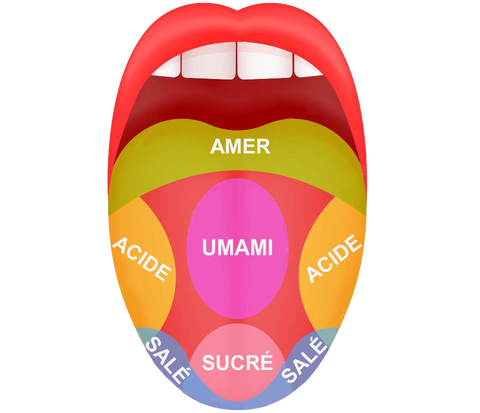
Not every part of the tongue detects the same flavours. The least familiar is umami!
The ultimate technique for looking like a true connoisseur (and picking up even more flavours) is retronasal olfaction: drawing a little air in through your mouth while keeping the wine in it, then breathing out through your nose.
👁️🗨️ Give it a go – it’s not rocket science! It takes a few tries to master this trick, but the restaurant waiter will never look at you the same way again.
Then you can finally swallow your wine, or spit it into a small container if you want to stay focused right to the end.
Tell us about the flavours. Which ones can you detect? Are they strong or subtle? Intense? Floral? Woody? Perhaps spicy?
-
For the connoisseurs – the three stages of tasting
The way you experience wine in your mouth can be broken down into three stages:
- The attack: the first contact and initial sensations in the mouth.
- The mid-palate: the wine develops in the mouth. The sensations generally become richer and more complex, allowing you to assess its body and balance.
- The finish: the impression left in your mouth after drinking the wine. It reveals the wine’s structure (including the quality and finesse of the tannins in red wines) and how long its flavours linger.
Now that you know what to look for, it’s time to enjoy yourself. Take your time and do what feels right to you.
Flakon is delighted to share this sensory experience with you and bring you closer to the world of wine. Because that’s what matters most!
Test your relationship (with wine, of course!) 🍇
A few simple questions to work out who’d make the best oenologist! 🥰 ****
👁️🗨️ Grab a piece of paper and write down your answers – no cheating, of course! 👀
1- Can any of you remember the name of the perfect glass for a true oenologist?
2- We dared to change your eating habits for this tasting, but what did we suggest you eat to keep other flavours from interfering?
3- True or false: is an amber-coloured white wine older than a golden-coloured one?
4- You’ve been paying such close attention that you can tell us what the drops running down the glass are called, right?
5- What’s the difference between the first nose and the second nose?
6- What is umami?
7- A little technical knowledge never hurts: what is retronasal olfaction for? (This one’s the hardest!)
8- What’s the best start-up in the wine world? (This one’s just for our ego)
Compare your answers. Now that you’ve got to know wine a little better, there are thousands of flavours to explore.
Tell us what you think!
Flakon aims to make learning about wine fun and accessible to everyone. As part of that mission, we want to offer you the best possible experience! Your opinion matters enormously to us, and we’d love you to be part of our development!
There’s a short questionnaire below that will only take a few minutes (promise)!
Flakon is always looking to improve!
A huge thank you!!


